When an AI Can Book Appointments, It Still Has to Know When Not To
A clinic wanted an AI voice agent that could handle calls, book appointments, collect patient information, and route patients to the right specialist. The hard part wasn't getting the AI to talk — it was making sure it never confidently did the wrong thing.
- Client
- Muhammad A.
- Industry
- Healthcare
- Engagement
- AI Engineering
- Duration
- 2 months
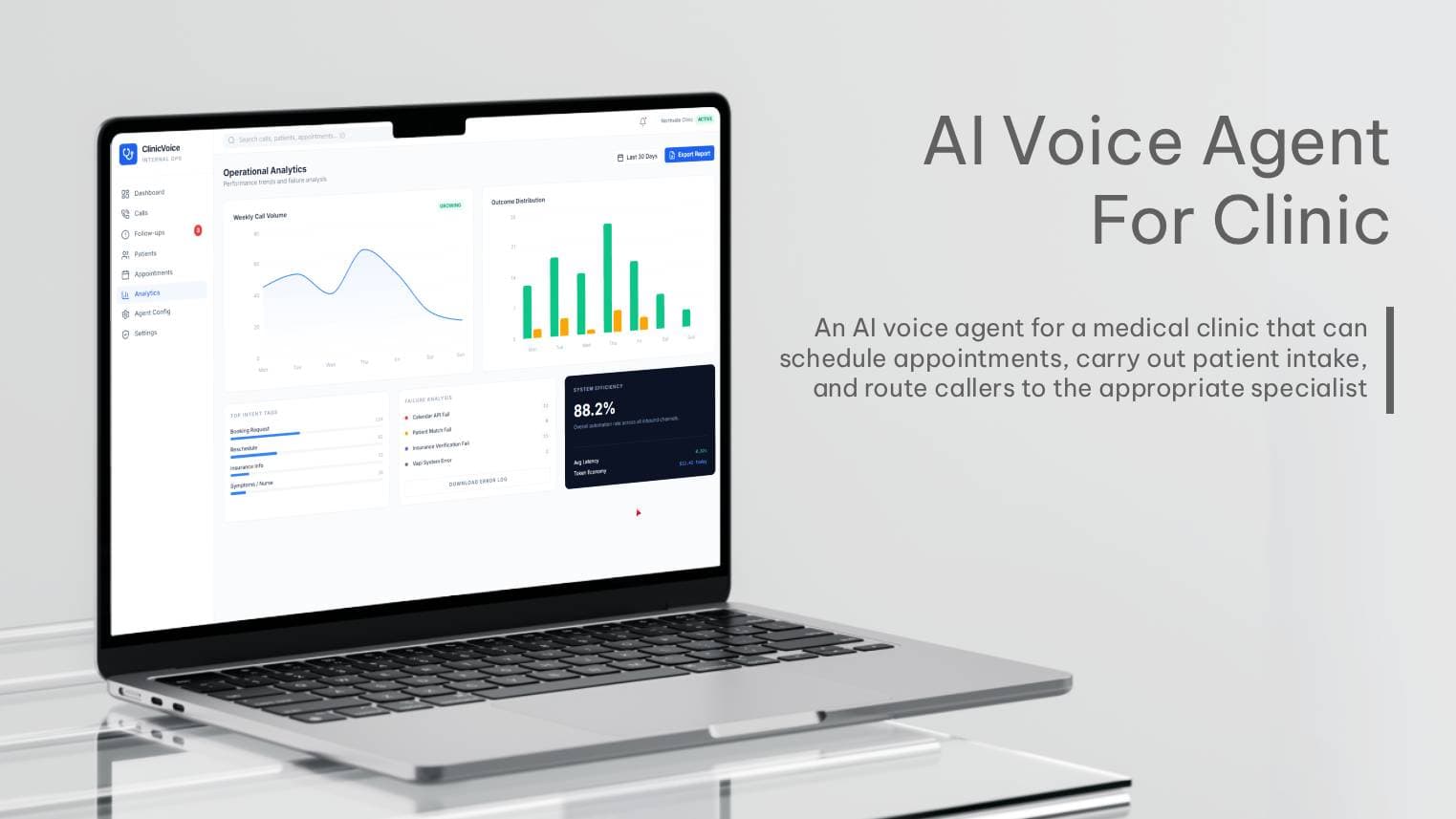
Key Results
- •24/7 routine call handling for appointment and intake workflows
- •Appointment booking, rescheduling, and cancellation through validated backend operations
- •Structured patient intake during natural voice conversations
- •Rule-driven specialist routing using patient information, availability, and clinic constraints
- •Duplicate-operation protection through idempotency, Redis locks, and conflict checks
- •Automatic escalation for uncertainty, urgent signals, tool failures, and conversational problems
- •Post-call summaries and structured outcomes for staff
- •Operational visibility through transcripts, follow-up queues, analytics, and audit logs
- •Reception Time Recovered: Routine calls that used to take staff time throughout the day are now handled by the AI, freeing the team to focus on the patients in front of them instead of the phone
The Clinic came to us with a straightforward problem: their reception team shouldn't have to handle every routine phone call.
They wanted an AI voice agent that could answer calls around the clock, book and manage appointments, collect information before a patient's visit, understand the reason for the call, and help route patients to the appropriate specialist. Staff also needed visibility into what happened during those calls, including transcripts, summaries, outcomes, and follow-up tasks.
On paper, it sounded like a voice-AI project. In practice, the difficult part wasn't making the agent have a natural conversation. It was making sure that everything happening underneath that conversation was actually correct.
A language model can sound completely certain while being wrong. That's one thing when you're asking it a general question. It's another when the answer becomes an appointment in a real calendar, a change to a patient's information, or a routing decision that affects what happens next.
So before we treated the agent as an automated receptionist, we had to answer a more important question: how much control should an AI actually have over a clinic's operations?
That question shaped the entire system.
What "AI Receptionist" Was Hiding
The AI couldn't be the source of truth
The first problem was deceptively simple. If a patient said, "Book me for Tuesday at 3," the AI needed to understand the request, but it couldn't be allowed to simply decide that the appointment had been booked.
The voice agent could interpret the conversation and request an action. The backend had to decide whether that action was valid.
Every consequential operation went through backend tools that checked the requested information, verified availability, applied the relevant clinic rules, and only then interacted with the connected scheduling system. The agent also used confirmation and read-back steps before completing important booking actions.
That separation mattered because it meant the model was responsible for understanding the conversation, not inventing the state of the clinic's systems.
The AI could say what it wanted to do. The backend decided whether it was actually allowed to happen.
Specialist routing couldn't be left to guesswork
The clinic also wanted patients routed toward the most relevant specialist based on what they described during the call.
A simple implementation would have been to send the patient's symptoms to an LLM and ask it to pick a doctor. That would have been easy, but it would also have made an inherently operational decision dependent on a model's interpretation alone.
Instead, the agent collected and structured what the patient was saying, while the routing system combined that information with the clinic's actual rules. Symptom-to-specialty mappings, doctor availability, department hours, insurance requirements, and other restrictions could all influence the final routing decision.
If the system couldn't establish an appropriate route, it could fall back to a safer option or escalate to staff rather than forcing a confident answer.
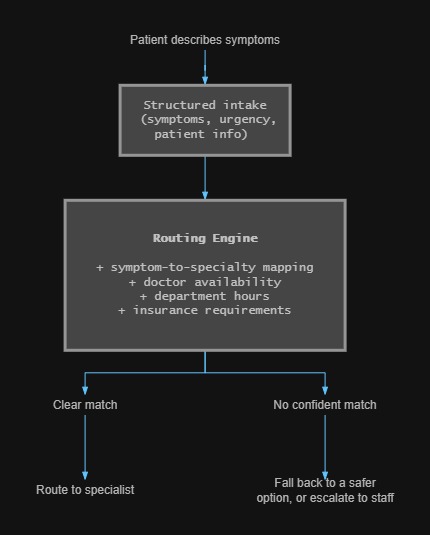
The AI helped understand the patient. The clinic's rules remained in control of the routing.
A successful conversation doesn't mean a successful operation
The more we considered the workflow, the clearer another problem became: a voice agent can have a perfectly successful conversation while the underlying operation has failed.
A calendar API can time out. An EHR integration can become unavailable. A network request can fail after the agent has already told the caller what it intends to do. A retry can accidentally submit the same operation twice.
Those are not conversational problems. They're software reliability problems.
So the system was designed to distinguish between the agent believing something happened and the backend actually confirming that it happened. Tool calls had defined validation and retry behavior, and failures could fall back to a staff follow-up path rather than being silently treated as successful.
The objective wasn't to make failures invisible.
It was to make them visible, bounded, and recoverable.
The same booking shouldn't happen twice
Voice workflows create another class of problems that isn't obvious during a demo.
A caller can repeat themselves. A request can be retried. Two operations can arrive almost simultaneously. A patient can call again while the first request is still being processed.
Without safeguards, those perfectly normal conditions can create duplicate bookings.
We added idempotency controls, Redis locks, and conflict checks around scheduling operations so that repeating a request didn't automatically mean performing it twice. Appointment details were also validated and confirmed before the final action.
It sounds like a small implementation detail.
In a system dealing with real appointments, it isn't.
Patients don't behave like API requests
There was another difference between a voice agent and a conventional backend workflow: people don't follow state machines neatly. They interrupt. They change their minds. They correct themselves. They give incomplete information and then remember something important thirty seconds later.
The conversation therefore needed explicit state and recovery paths rather than relying on the model to simply remember where the workflow was going.
The system could confirm intent, reset parts of a workflow when information changed, revalidate the relevant details, and continue without corrupting the rest of the interaction. If the conversation became stuck in a loop or the caller repeatedly needed something the system couldn't handle, the call could be escalated.
The goal wasn't to make every conversation perfectly predictable.
It was to make unpredictable conversations recoverable.
The system needed to know when to stop
The final piece was knowing when automation should end.
Urgent symptom signals, low-confidence situations, tool failures, repeated conversational loops, caller frustration, and uncertainty around specialist routing could all trigger escalation.
We didn't treat human handoff as a failure of the AI. It was part of the workflow. Most escalations play out that way — the system correctly recognizing its own limits, not the system breaking.
A useful automation system isn't one that insists on handling everything itself. It's one that knows which work it can handle reliably and when a person needs to take over.
Knowing when not to continue is part of the automation.
How We Actually Approached It
We didn't start by connecting a voice model directly to the clinic's systems. We separated the conversational layer from the business operations underneath it.
Vapi handled the real-time voice interaction, speech processing, prompting, and tool calling. Behind it, a FastAPI backend handled scheduling, patient intake, specialist routing, validation, notifications, integrations, and audit logging. PostgreSQL provided persistent storage, while Redis handled short-lived state, locks, and concurrency controls.
Work that didn't need to happen while a patient was waiting on the phone was moved into background processing. Call summaries, structured data extraction, follow-up tasks, analytics updates, retention processing, and alerting could all happen asynchronously rather than slowing down the live conversation.
That separation gave the system a simple operational boundary:
Conversation → Tool → Validation → Action
Instead of:
Conversation → AI says it happened
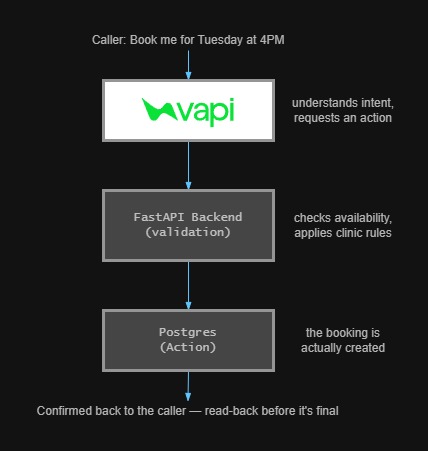
The distinction was fundamental. The voice agent could reason about what the caller wanted, but the backend remained responsible for whether an action was valid and whether it actually succeeded.
What Changed
The clinic gained a voice-based workflow capable of handling routine inbound calls around the clock. Patients could book, reschedule, or cancel appointments through natural conversation, provide intake information before their visit, and be routed according to the clinic's configured rules and actual availability.
Behind those workflows were the controls needed to make them dependable: idempotency, concurrency protection, validation, controlled retries, confirmation steps, audit logging, and defined escalation paths.
The system also gave staff visibility into what happened after a call. Transcripts and summaries could be processed automatically, structured outcomes could be recorded, and follow-up tasks could be created for situations that required human attention. Analytics exposed information such as booking success, call duration, common intents, and escalation reasons.
The result wasn't simply an AI that could answer a phone call.
It was a voice-driven operational system connected to the workflows that the clinic already depended on.
Where It Stands Now
The platform is capable of handling routine scheduling and intake interactions without requiring a receptionist to manually manage every step of the call.
The agent can perform routine work independently while maintaining defined paths to human staff when uncertainty, failures, or situations outside the automation's scope arise.
The important change wasn't that the clinic suddenly had a machine that could talk to patients.
It was that the conversation had become connected to a controlled system of real operations, validations, records, and follow-up.
The Stack
Backend
FastAPI • PostgreSQL • Redis • Celery
Integrations
AI Voice API • Twilio • Stripe
Architecture
FastAPI Service • REST APIs • Asynchronous Task Processing
Infrastructure
Docker • Linux • Reverse Proxy • AWS
Testing & Reliability
Automated Testing • Idempotency • Redis Locks • Conflict Checks
Thinking about handing a process over to AI?
The hard part usually isn't getting the AI to sound right — it's knowing exactly when it shouldn't be the one deciding.
We'll help you figure out where that line should be.