Revived a dying crypto exchange automation platform
How we rescued a failing trading engine by replacing a fragmented microservice architecture with a single, well-structured Django application, cutting latency from seconds to milliseconds.
- Client
- Chris J.
- Industry
- FinTech / Crypto Trading
- Engagement
- Legacy Modernization
- Duration
- 2 months
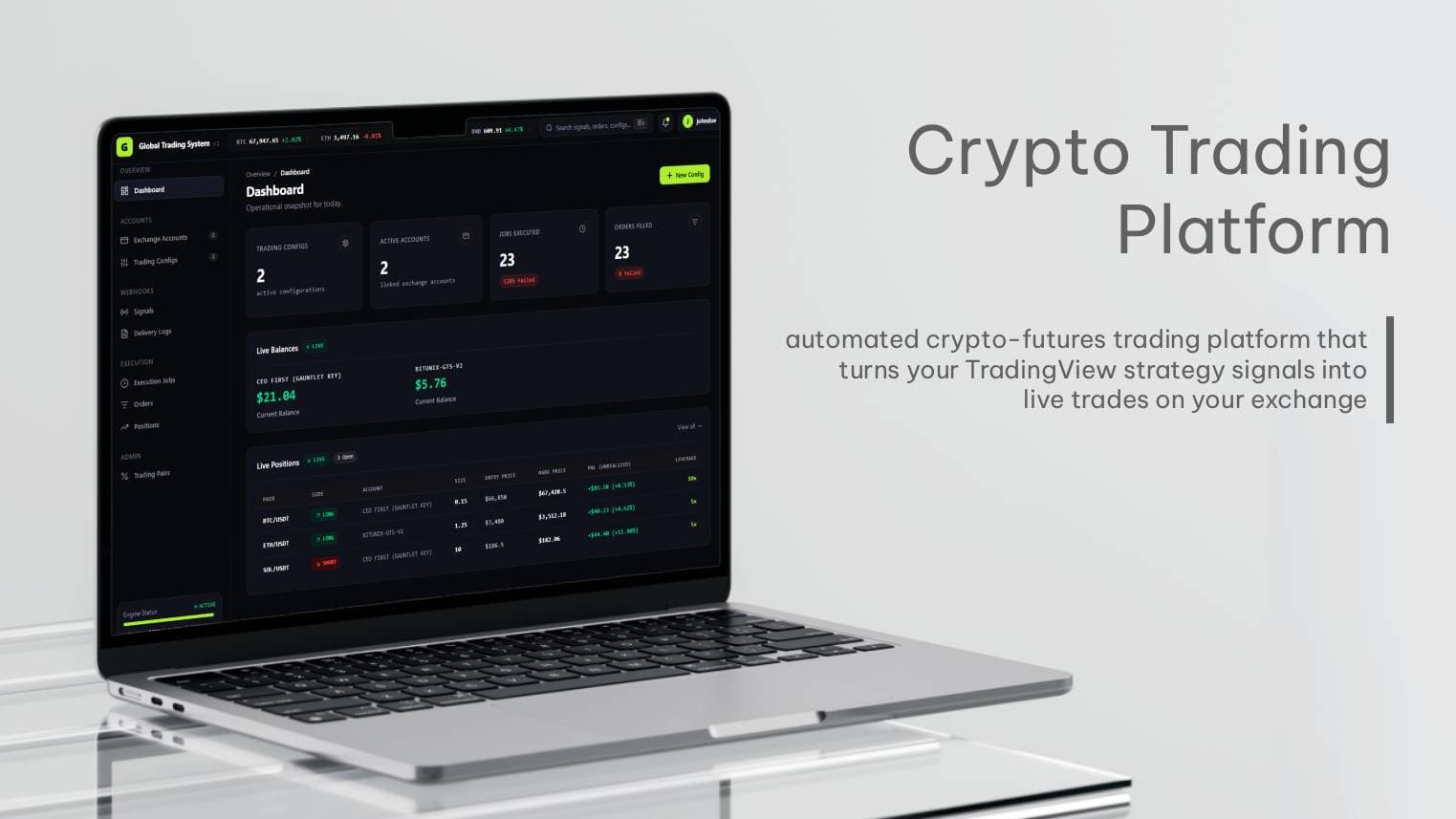
Key Results
- •Signal Speed: Cut signal-to-order latency from 10–15 seconds to under 200 milliseconds by replacing Selenium-based browser scraping with direct TradingView webhooks
- •Single Source of Truth: Consolidated three databases into one PostgreSQL instance with strict schema migrations and foreign key enforcement.
- •Precision Engine: Every order is now checked against the exchange's own quantity and price rules before it's submitted, so trades can no longer be rejected for violating a rule the platform already knew about.
- •Background Power: Implemented Celery for "limit-chase" logic and position tracking, ensuring the main app stayed responsive.
The client came to us with a crypto futures automation platform that was already operational.
On paper, the system looked sophisticated: multiple backend services, Docker, PostgreSQL, Redis, browser automation, and automated execution through the BitUnix exchange.
In practice, the architecture had accumulated more complexity than the product needed.
Trading signals were taking 10–15 seconds to reach execution. Services were tightly coupled despite being separated into multiple deployments. Data contracts between services were implicit rather than enforced. And exchange-specific trading rules weren't being validated before orders were submitted.
The platform didn't need another layer of infrastructure.
It needed someone to trace the entire system and determine where the complexity was actually helping—and where it was actively hurting the product.
That's what we did.
We traced the system from signal to execution
Rather than starting with a rewrite, we followed the complete trading path:
TradingView → signal ingestion → processing → strategy logic → order construction → BitUnix
This exposed several problems that weren't obvious when looking at individual services in isolation.
The system was using a browser where an HTTP request would do
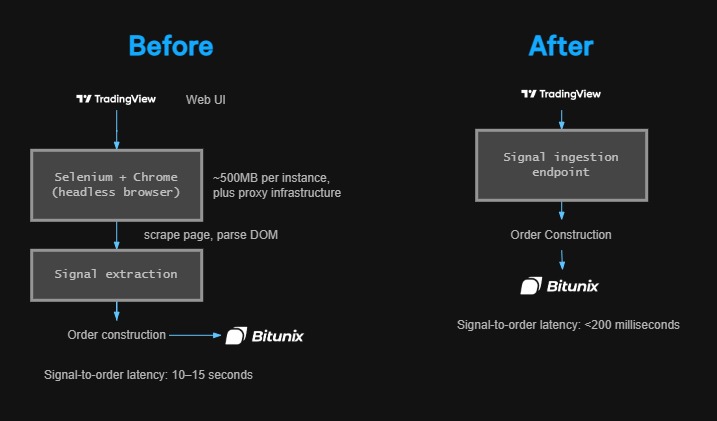
The original signal pipeline relied on Selenium instances to monitor TradingView.
That meant maintaining browser processes and proxy infrastructure simply to obtain trading signals.
It also introduced significant latency.
The measured signal-to-order path was taking approximately 10–15 seconds.
For an automated futures strategy, that's not a minor performance issue. A signal arriving several seconds late can mean entering at a materially different price—or missing the trade altogether.
TradingView already provided a much simpler mechanism for delivering signals: webhooks.
We replaced browser-based signal collection with direct webhook ingestion.
The result:
10–15 seconds → <200 milliseconds
We removed an entire browser automation layer from the critical trading path while dramatically reducing signal latency.
The microservices were creating complexity without providing independence
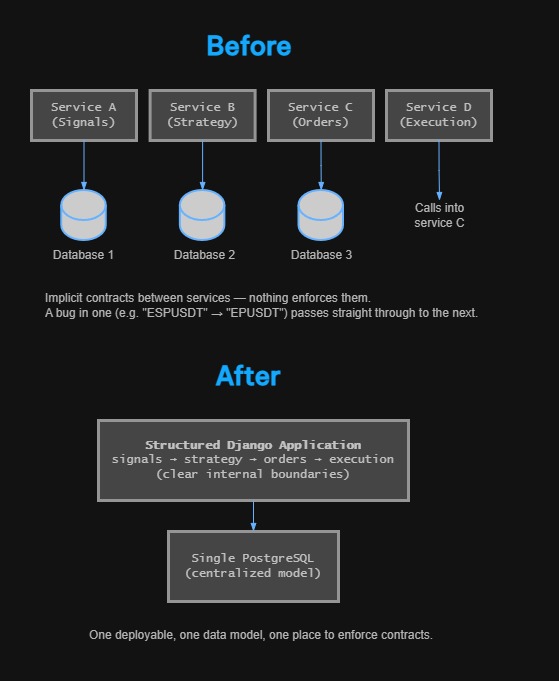
The platform had four backend services and three separate databases.
That sounds like a conventional microservice architecture.
But the services weren't truly independent.
They were tightly coupled, deployed together, and relied on assumptions about the data being passed between them. A change in one service could therefore break another service without either side having a reliable contract to detect the problem.
One bug demonstrated this particularly well.
A string transformation intended to process trading symbols accidentally removed the letter s.
A valid symbol such as:
ESPUSDT
could become:
EPUSDT
The downstream service accepted the malformed value because there was no contract test enforcing what a valid trading symbol should look like.
The problem wasn't simply a bad string replacement.
It was an architectural problem: critical assumptions were distributed across the system but weren't explicitly enforced anywhere.
Our response wasn't to add another service. We consolidated the platform into a structured Django application with clear internal boundaries and a centralized data model.
The goal wasn't to create a giant monolith.
It was to preserve separation of responsibility without paying the operational cost of unnecessary distribution.
The result was a system that was substantially easier to reason about, test, and debug.
Correct trading logic can still produce an invalid order
The next problem appeared at the exchange boundary.
The application could make the right trading decision and still construct an order that BitUnix would reject.
The reason was straightforward: exchanges impose their own rules around things such as:
- decimal precision
- quantity step sizes
- price increments
- symbol-specific constraints
The platform wasn't consistently validating these rules before sending orders.
That meant the application could discover an invalid order only after the exchange rejected it.
We introduced a dedicated execution and precision layer.
Before an order leaves the application, its price and quantity are normalized and validated against the applicable exchange rules.
The exchange is now the final execution authority—not the place where our application discovers that it constructed an invalid order.
The architecture was making testing harder than it needed to be
There was another consequence of the distributed design: testing.
Core business logic was spread across services and infrastructure dependencies.
A relatively small change could require multiple containers, databases, and service dependencies just to verify that the change behaved correctly.
That made the feedback loop unnecessarily expensive:
Change → deploy/integrate → discover failure → trace across services → repeat
After consolidation, core trading logic could be tested independently from the infrastructure around it.
That changed the engineering workflow from distributed debugging to ordinary application-level testing.
Instead of asking:
"Which service broke?"
we could ask:
"Which piece of business logic is wrong?"
That distinction matters when the system is responsible for executing real trades.
The Transformation
We didn't solve the problem by adding more infrastructure.
We removed infrastructure that wasn't earning its keep.
The resulting architecture is centered around a structured Django application, with Celery and Redis handling asynchronous workloads and PostgreSQL providing the central source of truth.
The trading flow became:
TradingView Webhook → Signal Processing → Strategy Logic → Order Validation → Exchange Execution
Each stage has a clear responsibility.
The system is simpler to operate, easier to test, and substantially faster along the critical execution path.
What Changed
| Metric | Before | After |
|---|---|---|
| Signal-to-order latency | 10–15 seconds | <200 ms |
| Signal ingestion | Selenium + browser automation | Direct webhooks |
| Application architecture | 4 tightly coupled services | Structured Django application |
| Databases | 3 separate databases | Centralized data model |
| Order validation | Exchange-side rejection | Pre-submission validation |
| Testing | Infrastructure-dependent | Isolated application logic |
| Debugging | Cross-service tracing | Centralized application stack |
| Browser infrastructure | Chrome + proxy runners | Removed from critical path |
The biggest improvement wasn't a single number.
It was predictability.
Signals arrive faster. Orders are validated before they reach the exchange. Business logic has fewer places to diverge. And when something does go wrong, engineers can trace the problem without reconstructing the state of several tightly coupled services.
The Engineering Principle
This project reinforced something we believe strongly at GrayLining: architecture should earn its complexity.
Microservices can be the right choice. So can a monolith.
The question isn't which architecture is more fashionable.
The question is:
What does the product actually need?
In this case, the original architecture had the operational complexity of a distributed system without enough independence to justify it.
So we simplified it.
We replaced browser automation with a direct integration.
We replaced implicit contracts with explicit boundaries.
We moved exchange-specific validation to the execution boundary.
And we replaced unnecessary distribution with a structured application that the engineering team could actually reason about.
The result wasn't simply a cleaner codebase.
It was a faster, more predictable trading system that is easier to operate and safer to evolve.
Where It Stands Now
The platform is live today, executing real trades for real users on real capital — not a staging environment or a demo account. The predictability the redesign was built around isn't theoretical anymore; it's what the system runs on, every day, with money actually on the line.
The Stack
Backend
Django • PostgreSQL • Redis • Celery
Trading & Execution
BitUnix API • TradingView Webhooks • WebSockets
Architecture
Django Monolith • REST APIs • Asynchronous Task Processing
Infrastructure
Docker • Linux • Reverse Proxy
Testing & Reliability
Automated Testing • Order Validation • Exchange-Specific Precision Handling
Not sure if your system's complexity is actually earning its keep?
Some architecture is solving a real problem. Some of it is just complexity nobody's questioned in a while — until it's costing you speed, reliability, or both.
We'll help you tell the difference.